
Custer County Projected Release Dates
A projected release date, often shortened to PRD, is an estimate used by the Oklahoma Department of Corrections. The Pardon and Parole Board glossary says ODOC calculates it. The Board does not. Credits for conduct and programs may move the estimate forward, while misconduct, a changed sentence, or a credit loss may move it back. ODOC also calls the future calculation tentative.
An actual release date records when a custodian stopped holding the person. The difference matters in Custer County. A projected date may pass without community release if ODOC recalculates the term, another case creates a hold, or another agency receives the person. A county release entry, an ODOC completed status, or a discharge response gives stronger historical proof than an old projection.
| Date or event | What it means | Best source |
|---|---|---|
| Bond or court date | A legal step that may allow release after processing and other holds | Custer County court docket |
| Projected Release Date | ODOC’s current estimate for a sentenced state prisoner | ODOC record or sentence administration |
| Parole eligibility or hearing | A review milestone, not a walk-out date | Pardon and Parole Board records |
| Actual departure | The time the named custodian stopped holding the person | Sheriff release log or completed ODOC status |
| Discharge | Completion of the relevant corrections or supervision term | ODOC discharge record or controlling court entry |
Find a Custer County Release Date
The lookup route changes with custody. The Custer County Sheriff’s current roster only shows people reported in custody and contains no public release-date field. ODOC’s system covers people received into state corrections. A court owns its orders but normally does not own the exact physical departure time. Keeping those boundaries clear prevents a bond posting, sentence, or projected date from being mistaken for a completed release.
- Identify the last known custodian: Custer County Jail, a city holding operation, ODOC, BOP, USMS, or ICE.
- For the county jail, check the current sheriff roster only for present custody. If the name is absent, ask for the booking and release entry.
- For a state sentence, search the ODOC offender lookup by name or ODOC number and compare identity, case, offense, status, and any projected information.
- Read the Custer County docket for bond, judgment, jail credit, sentence amendments, revocation, or dismissal. Treat these as legal context.
- Use Oklahoma VINE for a custody-event alert, then confirm the event with the sheriff, ODOC, or the receiving agency.
- Request the completed public record when an online entry is missing, unclear, or limited to a projection.
A state-sentenced person may remain in Custer County Jail while awaiting ODOC transport. ODOC reports that normal transport after sentencing may take six to nine months, with some short sentences and return-to-court cases prioritized. During that gap, “sentenced to ODOC” does not mean “received at an ODOC prison.” The county departure record and state reception entry mark two separate events.
The broader Custer County release record search explains how to request the jail’s actual release time, reason, and destination when public.
Custer County Jail Release Timing
A pretrial detainee has no sentence-based PRD. Release may depend on bond, recognizance, a dismissal or other court order, verification of warrants, and jail processing. A docket can show that bond was filed or a charge was dismissed, yet another case or hold may keep the person confined. The sheriff’s record supplies the actual departure time for Custer County custody.
County sentence completion also requires local proof. Search the judgment for the sentence and any jail-credit award, then request the jail’s departure entry. No official Custer County jail good-time chart or weekend-release policy was found. ODOC’s state-prison credit levels must not be applied to a short county sentence. If a calculated end falls on a weekend or holiday, do not move it to Friday without an official record or policy.
A focused sheriff request can identify the full name, booking number, case number, and narrow date range. Ask for booking time, actual release date and time, public disposition or reason, authority, and receiving agency or destination when public. The sheriff is at 300 N. 7th Ave., Arapaho, OK 73620, phone 580-323-1616. Administration lists Monday through Friday, 8:30 to 4:30, while the county directory lists 8:00 to 4:00.
Note: Ask about delivery and fees first because no sheriff-specific online release-record fee, turnaround, or email-delivery promise was found.
ODOC Custer County Release Lookup
The ODOC lookup is not a copy of the county jail roster. It applies after a person enters state corrections. Public information can include the name, ODOC number, image, physical identifiers, status, facility or supervision information, offenses, sentences, and projected-release information. Search by full name or ODOC number, then compare the photograph, date of birth, Custer County case, offense, and reception details before relying on a match.
ODOC warns that its public information is abbreviated and that a data-source migration created issues. The offender-information gateway also says an exact future release date is confidential unless the requester shows a legitimate qualifying need. The incarcerated person receives days remaining and may share the calculation. A public PRD can be noted when displayed, but the absence of that field does not authorize a home calculation or prove there is no date.
The official ODOC release-date FAQ is shown in the manifest image below. It supports the distinction between a tentative agency calculation and a completed public discharge record.
The ODOC image identifies the agency path for state prisoners, while a Custer County jail release must still be confirmed through the sheriff.
If the interactive record is unclear, use ODOC Legal Services at 405-425-2515 or the published discharge address, osordischarges@doc.ok.gov. A public-record request should seek a completed release or discharge date and category, not demand a confidential exact future date.
Custer County PRD Credit Rules
For an ODOC sentence, Oklahoma’s earned-credit statute is 57 O.S. Section 138. ODOC policy OP-060211 implements regular Levels 1 through 4 at 0, 22, 33, and 44 days per month. Eligible enhanced Levels 3 and 4 earn 45 or 60. One credit equals one day. Placement depends on conduct, work and program performance, participation, and institutional adjustment, with review at least every four months.
The numbers are inputs, not a public calculator. Sentence length, legally recognized jail credit, concurrent or consecutive cases, offense date, amendments, escape time, achievement credits, restricted-credit rules, and disciplinary losses or restoration can all matter. Misconduct may remove credits. Restoration is discretionary. ODOC’s PRD worksheet models ordinary changes but excludes restricted-earned-credit sentences from those ordinary projections.
Oklahoma’s 21 O.S. Section 13.1 creates an 85-percent floor only for listed serious offenses and related attempts, conspiracies, or solicitations. It is not a rule for every Oklahoma sentence. Credits cannot reduce covered time below the floor, and reaching the threshold means eligibility for consideration rather than guaranteed parole or release.
The official Section 13.1 source appears in the manifest capture below. The live statute should be read because its covered-offense list can change.
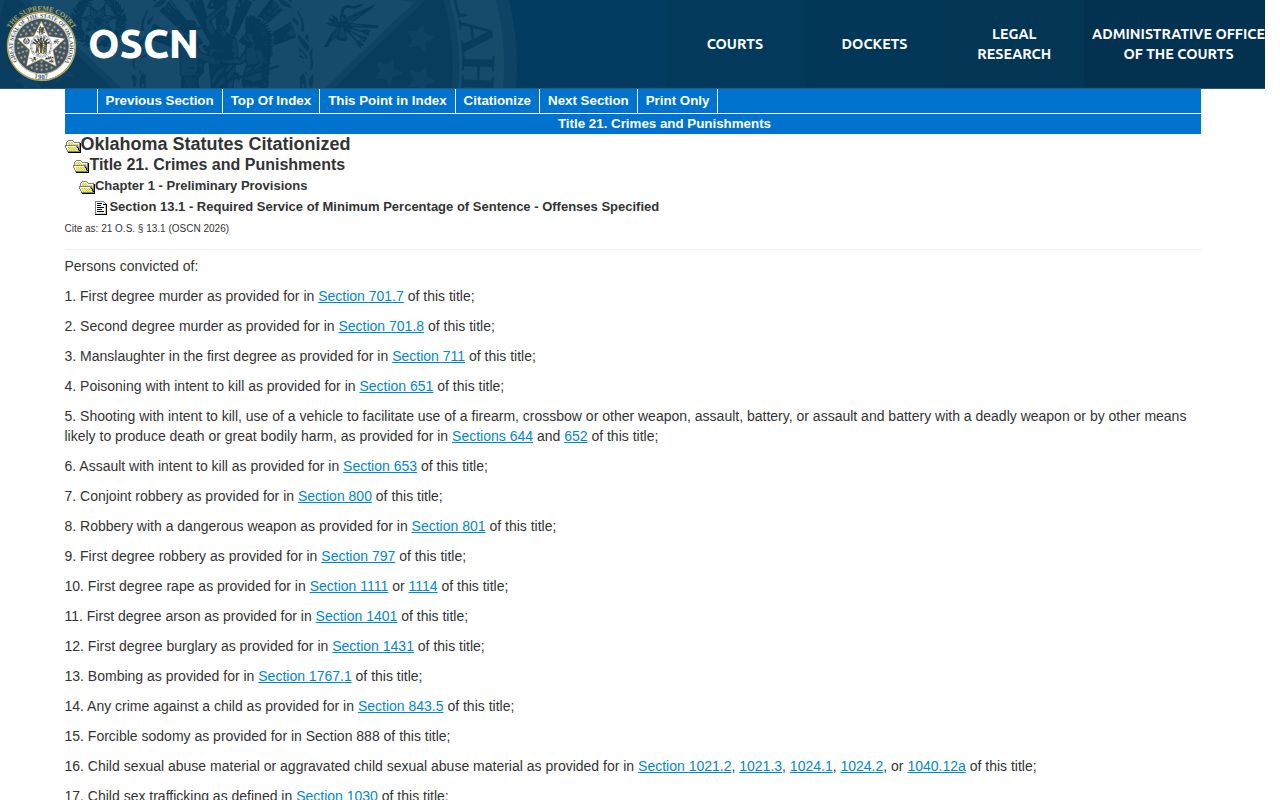
The statute image anchors the offense-specific limit; it does not replace ODOC’s person-level sentence calculation.
- Jail credit
- Time that the court or sentence administrator lawfully credits toward the sentence.
- Earned credit
- Days applied under ODOC law and policy based on class, conduct, work, or programs.
- Restricted credit
- A legal limit that prevents ordinary credits from reducing a covered sentence below a set floor.
- Projected Release Date
- ODOC’s current estimate, subject to later change.
Who Calculates Custer County PRDs
ODOC calculates the PRD for a state prisoner. The Oklahoma Pardon and Parole Board does not. This distinction is the key Custer County release-date angle because Board records, ODOC credit records, and county jail records can all display different milestones for the same case. The Board’s glossary separates Initial Parole Eligibility Date, PRD, and Board action. None alone shows that a person physically left custody.
A useful evidence chain begins with the Custer County judgment, continues through ODOC reception and sentence administration, and ends with the completed release or discharge record. If parole occurs, check the Board outcome and then the ODOC departure and supervision status. If the date changes, look for credit class, achievement credits, misconduct, restoration, a sentence amendment, or a restricted-credit rule before assuming the earlier record was false.
For county jail time, the chain stays local. The judgment and jail-credit ruling explain the legal term, while the sheriff’s entry proves departure. No verified local good-time schedule was found, so an ODOC credit table cannot fill that gap.
Custer County Release Date Changes
A future date can move for lawful and practical reasons. Some changes alter the sentence calculation. Others do not change the sentence but change when or where the person leaves. The source for each factor should be checked before the date is reported as final.
| Factor | Possible effect | Where to verify |
|---|---|---|
| Credit class or achievement credits | May move an ODOC projection earlier as credits are earned and applied | ODOC sentence administration |
| Misconduct or credit loss | May move the projection later; restoration is not automatic | ODOC record or authorized calculation |
| Court order or sentence amendment | Can change the legal term or credit awarded | Custer County court record and ODOC update |
| Detainer or another warrant | May change the destination or prevent community release | Holding and receiving agencies |
| Parole action | May create a path to supervised release but does not itself prove departure | PPB result followed by ODOC status |
| Data delay or correction | May cause systems to show different dates for a time | Official custodian record |
A detainer deserves special care. Custer County custody can end through transfer to ODOC, another county, USMS, or ICE. That is a departure from the county jail, not proof of return to the community. Ask the sheriff for the receiving agency and timestamp when those fields are public.
Confirm Custer County Release Dates
Use Oklahoma VINE to monitor a custody event for a participating agency, then verify the result with the custodian. A VINE release event reflects the reporting agency’s feed and may represent a move to another authority. The Custer County VINE inmate check explains the one-person notification route. It should support, not replace, the official release record.
For a historical county event, request the sheriff’s release log. For completed state custody, seek the ODOC public status or discharge record. For a federal sentence, BOP may show a release date and “Released” or “Not in BOP Custody,” but another authority or supervision may remain. ICE’s locator is current-only, so a no-match does not prove immigration release.
Record the system, query, search date, and identifiers used. If two official sources conflict, report both and ask the custodian for the underlying record. A projection can legitimately differ from the eventual departure date, and a court event can precede physical release by hours or longer.
Note: The most reliable wording identifies whether a date is projected, ordered, eligible, actually released, or fully discharged.