
Custer County ICE Release Paths
No ICE detention facility was located physically in Custer County in the official locator material reviewed. This is a directory finding, not proof that no short federal hold or contract placement can occur. The practical point is that a transfer from the sheriff normally sends the verification task outside the county. The Custer County release entry owns the local departure time and should identify ICE as the destination when that information is public.
After the handoff, ICE owns its detention and later departure record. A person may be released under immigration conditions, transferred to another ICE site, removed from the United States, moved to another agency, or remain detained. A blank online result cannot choose among those outcomes. Use careful wording: “released by Custer County to ICE” when the local record supports that handoff, and reserve “released from ICE custody” for an ICE record that establishes it.
County release to ICE
Custer County custody ends, but government detention may continue under immigration authority.
ICE departure
An ICE record is needed to establish when immigration custody ended and what outcome followed.
Search ICE Detainee Status
Use the ICE Online Detainee Locator System for a person who may currently be in ICE custody or in Customs and Border Protection custody longer than 48 hours. It is not a historical release archive. Search with the data required by the current interface.
- Use the A-number route when possible. Enter the nine-digit number, adding leading zeroes when needed, plus country of birth.
- Use exact identity for a name search. Enter the recorded first and last name, date of birth, and country of birth.
- Compare the result. Match every available identifier before relying on a detention location.
- Check the county handoff. Request the sheriff’s destination and departure time when the path began at Custer County Jail.
- Escalate an unresolved result. Use ICE records or the proper Enforcement and Removal Operations channel for clarification.
The locator excludes people under 18. A no-match can reflect exact-name failure, processing delay, transfer, age restrictions, departure, or custody by another agency. Say only that no current match was returned.
ICE Release Evidence Fields
ICE’s current locator is a location tool, while a county release log is a departure tool. A strong check begins with the identifier that links them. Ask the sheriff for the public destination or receiving agency and actual handoff time. Keep the A-number private except where it is needed for an official inquiry, and avoid sending extra personal data through unsecured channels.
| Evidence | What it proves or limits |
|---|---|
| Custer release time | Shows when county custody ended. |
| Destination or receiving agency | Can establish the reported ICE handoff. |
| A-number and country of birth | Enable the more precise current locator search. |
| ICE locator result | May show current detention; it does not preserve release history. |
| ICE record response | Can address the immigration detention segment subject to access limits. |
A court dismissal, paid bond, or county release code does not establish ICE’s later outcome. Likewise, a BOP or ODOC departure can be followed by ICE custody. Trace each custodian in order.
ICE Records and Contact Route
Begin with the locator, then use ICE’s official contact and records channels when the result is unclear. The research does not identify an ICE detention address or public release-hours office in Custer County. None should be invented. Ask the agency that holds the relevant record for the appropriate process and identity proof.
ICE Custody Channels
Current location: ICE Online Detainee Locator System
Case clarification: Appropriate Enforcement and Removal Operations field office
Historical records: ICE records process
Custer County facility: No physical ICE detention facility was located in the official material reviewed.
Release, transfer, removal, and supervision information can be subject to privacy and immigration-record rules. A general requester may receive less than the person or an authorized representative. State what event and date range are sought, and ask for separable public information rather than assuming the online locator retains it.
Custer County Detainer Timing
The official ICE detainer explanation says a detainer asks another law-enforcement agency to maintain custody for up to 48 hours after the person otherwise would be released, excluding Saturdays, Sundays, and holidays under the cited framework.
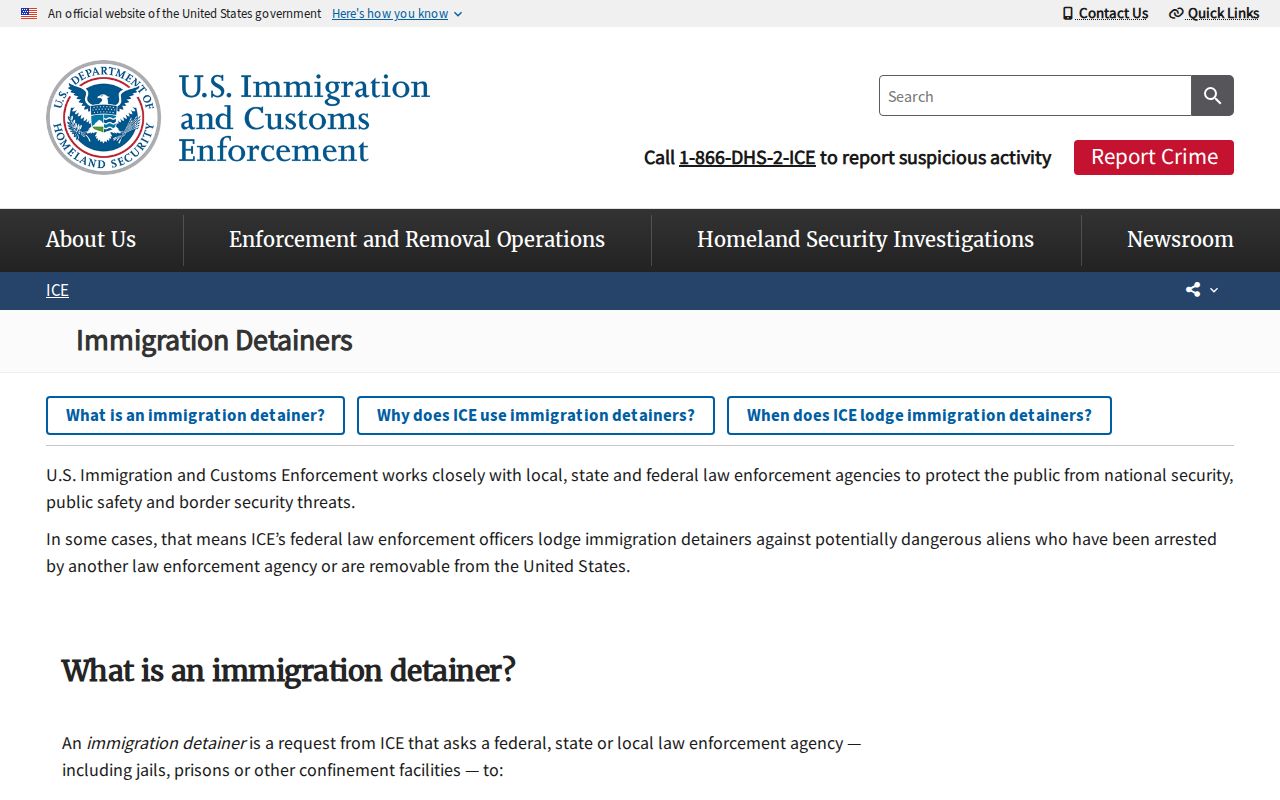
The source explains how Custer County authority and physical confinement can diverge. It does not prove that a detainer existed in a specific case. Seek the sheriff’s release or transfer record and the ICE record before describing an individual handoff.
Confirm Custer ICE Handoff
Search the sheriff’s current roster first only if Custer County Jail was the last known custodian. The page is current-custody only. If the person is absent, request the actual release time, public disposition, and receiving agency. A missing name does not establish an ICE transfer on its own.
If the county record names ICE, run the exact-match locator search. If a current location appears, it supports continued immigration detention at the search time. If nothing appears, contact the proper official channel. The Custer County Jail release page explains how to document the local segment without calling a transfer a community release.
Custer County Custody Door Map
OJA material identifies the Custer County Jail and the Clinton and Weatherford city holding operations as separate local entry points. Its juvenile-compliance context does not establish current adult capacity, release hours, or ICE arrangements. It serves only as a map of the local agencies that might start the custody chain.
A city arrest can lead to municipal release, county transfer, and then a later ICE handoff. Obtain the city departure record, county booking and release record, and immigration record as separate items. That sequence prevents the first local departure from being mistaken for the final end of government custody.
ICE No-Match Release Limits
“No current match” is the most defensible wording after an unsuccessful locator search. It does not mean never detained, no longer detained, or released. Exact spelling, country of birth, date of birth, A-number formatting, update lag, transfer, the under-18 exclusion, and another agency’s custody can all affect the result.
Search records should note the tool, input method, and date. If an A-number search and a name search differ, preserve the conflict and seek the agency record. Do not use an unverified social-media image or a shared name to bridge identities. Compare full legal name, aliases, birth data, case identifiers, and the Custer County handoff details.
ICE Release After State or Federal Custody
Immigration custody may follow county, ODOC, BOP, or USMS custody. An ODOC discharge record proves the state term’s status, not ICE release. A BOP result of “Released” or “Not in BOP Custody” ends the BOP question but allows another custodian or federal supervision to remain. Federal court and USMS records may be needed for the pretrial segment.
Read each record within its boundary. The Custer County released-person guide maps the full county, state, federal, VINE, court, and immigration sequence. When the destination remains unknown, say so. Do not fill it with a claim that the person returned home.
Report ICE Release Carefully
A clear report names the agency and event: Custer County released the person to ICE; ICE’s locator showed current detention at the time searched; or ICE records showed a later departure. These are distinct claims. A court order may explain legal authority, but the physical custodian owns the departure time.
Where sources conflict, prefer the official record for the fact its agency owns and seek the underlying response. A delayed locator update and a sheriff transfer entry can both be accurate at different moments. Preserve those times. If ICE release is confirmed but the next destination is not, state only that immigration detention ended.
Keep a record of the exact locator route, spelling, A-number format, country of birth, and search date. If a later query produces a different result, the earlier log helps distinguish a true status change from corrected input or feed delay. Use only confirmed identifiers, and seek an official response when two people share a name.
The A-number route requires nine digits, including leading zeroes, plus country of birth. A name search needs the exact recorded first and last name, date of birth, and country of birth. The locator excludes people under 18 and is not a historical archive. A failed match may reflect input rules, delay, transfer, age limits, or another agency.
Note: An ICE locator failure is a search result, not a historical release record or proof of present freedom.