
Clinton City Holding Release Paths
A person can leave Clinton Police custody in more than one way. The municipal matter may end in release, or the person may move to Custer County Jail or another agency. A move between custodians is a transfer, even though Clinton’s hold has ended. It does not show that the person returned to the community. The Clinton departure entry and receiving agency, where public, are the clearest first proof.
Do not begin by treating the sheriff roster as a history of Clinton holds. It covers people currently in Custer County Jail. It becomes relevant if Clinton transferred the person there. Likewise, a court docket explains the citation, warrant, bond, dismissal, or judgment, but it usually does not own the exact physical departure time. A strong result places police, court, and any receiving record in sequence.
Municipal departure
Ask Clinton Police for the time, disposition, and transfer destination tied to the city hold.
Later county custody
Use a matching Custer County booking and eventual release entry as a separate custody episode.
Confirm Clinton Holding Release
Call Clinton Police with a narrow request. Give a full legal name, aliases, birth information, citation or incident number, and date range. Ask whether the person was held by Clinton, when the hold ended, and whether departure was a release or a transfer. If the person moved, ask for the receiving agency when that field is public.
- Confirm the arresting agency. Clinton Police, Oklahoma Highway Patrol, and county officers lead to different record and court paths.
- Seek the city log. Request the booking, cell, departure, or transfer entry for the identified event.
- Select the proper court. Clinton Police citations go through Clinton Municipal Court; state or county matters may appear in district court.
- Follow a transfer. Search the receiving custodian and compare identity, charge, and time.
- State the limits. A no-match or absent roster name proves only what that system displayed at the search time.
Do not use payment, dismissal, or a bond event as the jail release timestamp. Other holds, warrant checks, paperwork, or transfer arrangements can keep custody in place after a court event. Ask the police custodian for the actual departure.
Clinton Release Record Request
Clinton has no official public historical release view in the source material. A focused records request is the practical route. Seek the custody entry rather than asking the police to interpret the whole court case. Name the person and event, then ask for public fields that distinguish a local release from movement into another jail.
| Request item | Purpose |
|---|---|
| Incident, citation, or hold number | Links the response to the right municipal event. |
| Entry and departure times | Defines the period of Clinton Police custody. |
| Disposition | Separates release, transfer, or another recorded outcome. |
| Receiving agency | Identifies the next place to verify custody. |
| Related case identifier | Points to the right municipal or district docket. |
No Clinton address, holding hours, fee schedule, public retention period, or online release form was confirmed in the research. None is supplied here. Ask the police department how to submit and receive the record, whether a fee applies, and whether any part must be inspected in person. Privacy, juvenile, sealed, safety, and active-case rules may limit disclosure.
Clinton Police Release Contact
The city-published Clinton Police number is the verified contact route for the holding operation. Use it to ask for the appropriate records custodian and submission method. The call should focus on a defined person and event. Avoid sending more sensitive data than is needed to distinguish the record.
Clinton Police
Phone: 580-323-2323
Release records: Ask for the police records channel for the specific municipal hold.
Address and hours: Not stated in the researched facility material; confirm directly.
If the response says the person was transferred, ask when Clinton custody ended and which agency received the person. If the answer is a local release, ask for the recorded time and public disposition. Keep that statement separate from later supervision or another unrelated case.
Clinton Municipal Court Record Split
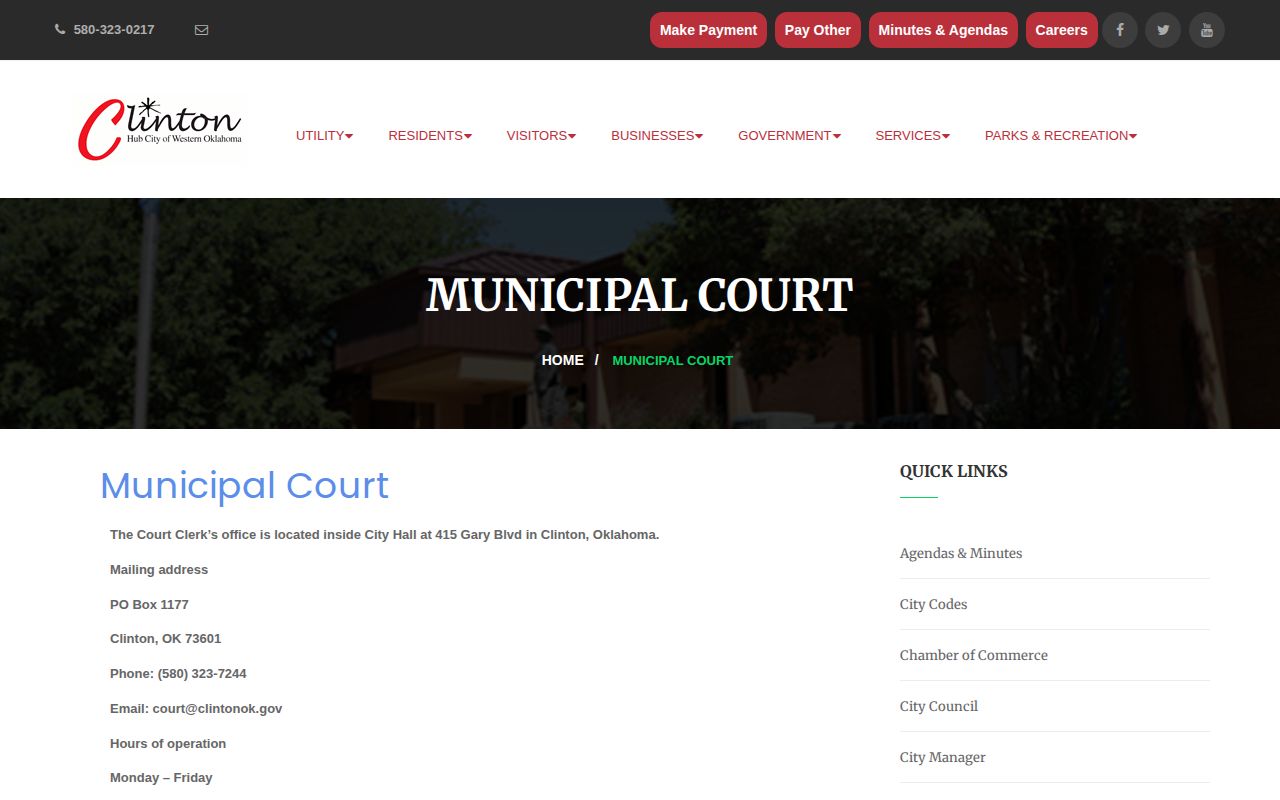
The official Clinton Municipal Court page explains a local jurisdiction split: the municipal court handles Clinton Police citations, while Oklahoma Highway Patrol citations are directed to Custer County District Court.
This split can explain why one court search finds nothing. It also prevents a city citation from being confused with a later county felony or misdemeanor file. The docket remains legal context. Clinton Police or the later custodian must confirm physical departure.
Clinton Warrants and Release Timing
The municipal court states that failure to appear can produce a warrant and a $25 warrant fee, and that unpaid matters after 60 days may lead to collections charges. Those facts can explain why a municipal case produces later police contact. They do not prove when the person was released from a cell, whether another hold existed, or whether payment caused immediate departure.
Read court actions and custody events on their own terms. A warrant may explain the arrest. A payment or dismissal may address that case. The holding record shows when the person left Clinton custody. If another warrant or county matter existed, the person may have transferred despite resolution of the municipal charge. Avoid turning one case’s disposition into a statement about all custody.
Custer County Custody Door Map
OJA authorized-jails material identifies Custer County, Clinton, and Weatherford as separate local custodial entry points. For Clinton research, that distinction is the core facility-history angle. It shows why the booking agency must be identified before a request is sent and why one person can have a city departure followed by a county booking.
The OJA document concerns authorization for limited juvenile holding. It does not prove present adult capacity, ordinary release hours, or a current release policy. Do not draw those claims from it. Use it as a map of possible custodians, then rely on Clinton Police, the sheriff, the correct court, and any receiving agency for the actual event.
Trace Clinton Transfer Records
When Clinton reports a county transfer, search the Custer County sheriff’s current page only to see whether the person is presently listed. If absent, request both the city transfer entry and the county booking or release entry. Matching times may still differ because one agency records departure and the other records reception. Preserve the gap rather than filling it with a guess.
Compare full name, aliases, birth information, case or citation number, charges, and event dates. The Custer County Jail records guide covers the county segment. For an older matter, the official court record may outlast online custody entries. A sealed or expunged case may no longer appear publicly, so a blank result does not prove that the hold never occurred.
Note: “Released by Clinton” should be qualified as community release or transfer whenever the police record supplies that distinction.
Report Clinton Release Results
A careful conclusion names the source and the fact it owns. For example, the municipal docket may show dismissal, Clinton Police may show transfer at a later time, and the sheriff may show reception into county custody. Those facts are compatible. They describe a legal event followed by two physical custody events.
If Clinton confirms departure but gives no destination, state only that city custody ended. If the current sheriff roster does not list the name, say the person was not found in that current snapshot. Use the Custer County released-person search for state, federal, immigration, VINE, court, and record-request fallbacks. Do not turn an unknown destination into a claim of return to the community.
For an older Clinton matter, request the official docket and named orders rather than asking court staff to decide whether someone was released. A bond entry, dismissal, or sentence can explain authority but not the physical time. Sealing and expungement can remove public results, and juvenile matters have separate limits. If no online case appears, report that search outcome without stating that no arrest or hold occurred.
Document the full identity used in each search. Compare aliases, middle name, birth information, citation or incident number, county case, charges, and dates. A shared name is not enough when another field conflicts. If the city and county records disagree, ask each custodian for its underlying entry and preserve both timestamps until the transfer sequence is clear.
Clinton Municipal Court states that failure to appear can produce a warrant and a $25 warrant fee, while unpaid matters after 60 days may receive collection charges. Those facts can explain later custody. Payment or case disposition still does not establish when the police cell opened, so ask Clinton Police for the holding disposition.