
Custer County Parole and Probation
Oklahoma divides parole and probation work between different public bodies. The Oklahoma Pardon and Parole Board publishes parole dockets and results. It considers a person for parole and records the Board outcome. The Oklahoma Department of Corrections, or ODOC, manages community supervision. A favorable Board result is one step, not proof that a person left prison. ODOC status, release processing, any required executive action, conditions, and holds may still affect the actual departure.
Probation usually comes from a court judgment. A suspended sentence is a conviction for which some or all confinement is suspended, often with ODOC supervision under state law. A deferred sentence postpones final sentencing while the person meets court terms. Successful completion can lead to dismissal and a record update under Section 991(c), but that is not the same as parole or a full expungement. Reading the court case with the ODOC entry helps keep these paths distinct.
| Status | How it begins | What confirms it | What it does not prove |
|---|---|---|---|
| Parole | Release from prison for the balance of confinement after the Oklahoma parole process | Completed ODOC prison departure and a community-supervision entry | That the sentence has fully ended |
| Probation | A court order, often tied to a suspended or deferred sentence | The judgment, later court filings, and ODOC supervision status | That the person was first released from an ODOC prison |
| Discharge | Completion or formal end of the corrections or supervision term | An ODOC discharge record or controlling court entry | That every separate case or duty has ended |
- Parole
- Community release while the balance of a prison term remains subject to supervision.
- Probation
- Court-ordered community supervision instead of, or after, some confinement.
- Absconder
- A person alleged to have stopped reporting or left supervision without permission.
- Detainer
- A request or hold from another authority that may block release or change the destination.
Verify Custer County Release Supervision
Start with the system that owns the fact. The ODOC offender lookup can show a public status, supervising location, offenses, sentences, and related identity details. A community-supervision entry supports that the person is outside prison under ODOC oversight. It should be matched by full name, ODOC number when known, date of birth, photo, offense, and Custer County case information. A name alone is not enough when two people share it.
- Search ODOC by full name or ODOC number. Accept the official disclaimer and note the date of the search.
- Open the likely match and compare identity, offenses, case information, status, and the listed facility or supervision office.
- Check the PPB docket archive if parole consideration was recent. Read the matching result and minutes without treating a favorable outcome as a completed release.
- Use the Custer County court docket to identify probation, suspended or deferred terms, revocation filings, and satisfaction entries.
- Contact the listed ODOC office when the public entry is unclear or the proper operational unit must be identified.
The court and corrections records answer different questions. A docket may show why supervision was ordered. ODOC shows the public corrections status it administers. The county release record answers when Custer County Jail stopped holding the person, while ODOC proves later state reception, prison departure, or community supervision. The full county search path and release-record request are covered on the Custer County released-inmate search.
Custer County Supervision Office Route
ODOC assigns Custer County to the Weatherford Probation and Parole Office. This local route is distinct from the Pardon and Parole Board. The Board considers and records parole action; the Weatherford office handles community supervision within its assigned area. A public ODOC record should be checked first so staff can be given an ODOC number, full identity, and the specific status question.
The official ODOC probation and parole directory is the source for the local assignment:
Weatherford Probation and Parole
1401 Lera Drive, Suite 6
Weatherford, OK 73096
Phone: 580-772-0247
Service area: Custer County
Ask a narrow question, such as whether the directory office is the right point for a public Custer County supervision inquiry. Staff may limit details that are not public. If the person transferred supervision to another state, ODOC’s Interstate Compact Unit handles transfers, warrants, and retakings at 405-425-2603. The Oklahoma judgment can remain relevant even when the person reports outside Weatherford.
The manifest image below captures the official statewide directory that identifies the Custer County route. The office entry gives a direct way to distinguish local supervision from the Board’s separate parole-decision process.
View the official ODOC probation and parole office directory.
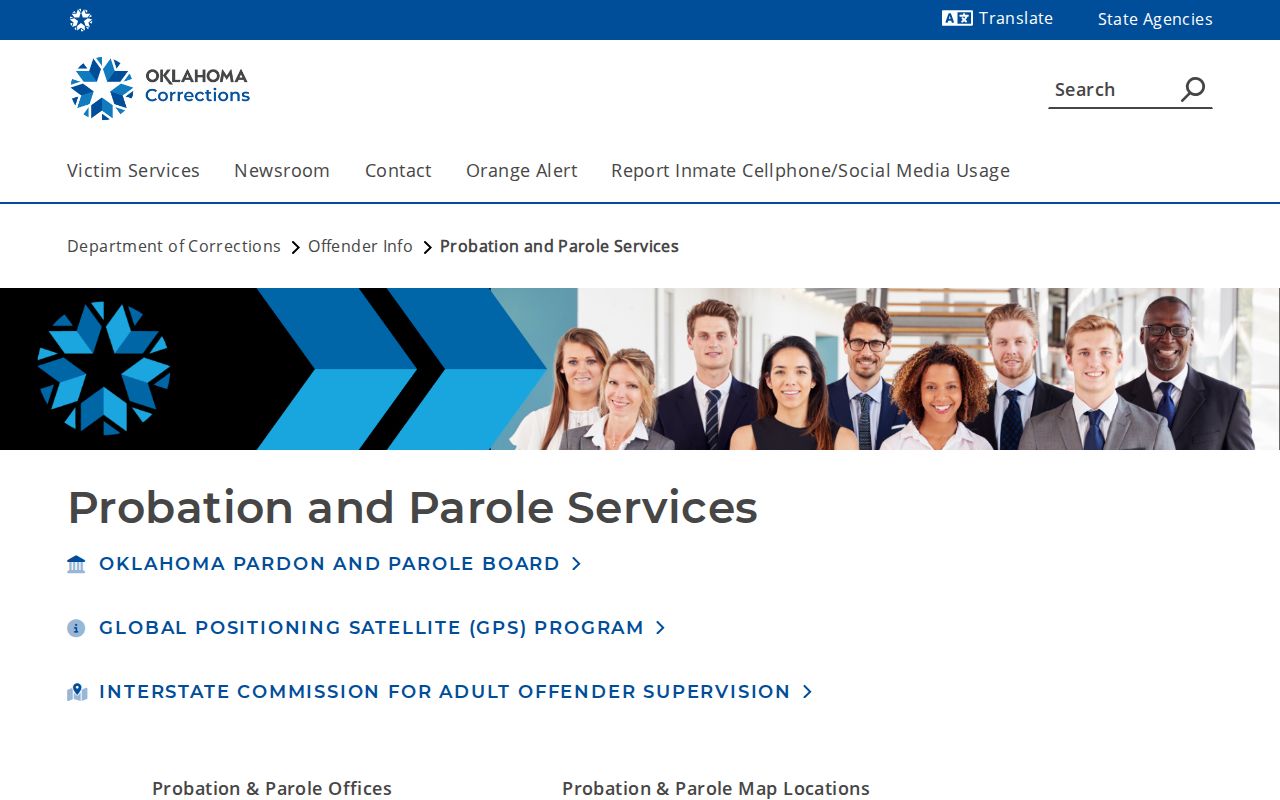
The directory image supports the Weatherford contact route; it does not disclose a person’s individual supervision file.
Custer County Parole Decision Records
Parole has several milestones. The Initial Parole Eligibility Date is the earliest review point. A Board docket identifies scheduled consideration. A result records what the Board did. The projected release date is ODOC’s sentence estimate, and actual departure is a later custody event. These dates must not be merged. A detainer can also keep a person confined or move the person to another custodian after favorable action.
The PPB meeting page publishes annual and monthly material, including agendas and minutes. The docket archive is organized by year and month. Terms such as favorable, denied, passed, no action, stricken, or rescinded should be reported as printed. An outcome should not be translated into “released” until ODOC shows that the prison departure occurred.
The official Board calendar is visible in the manifest capture below. It helps identify the right month before a person-level docket and result are checked.
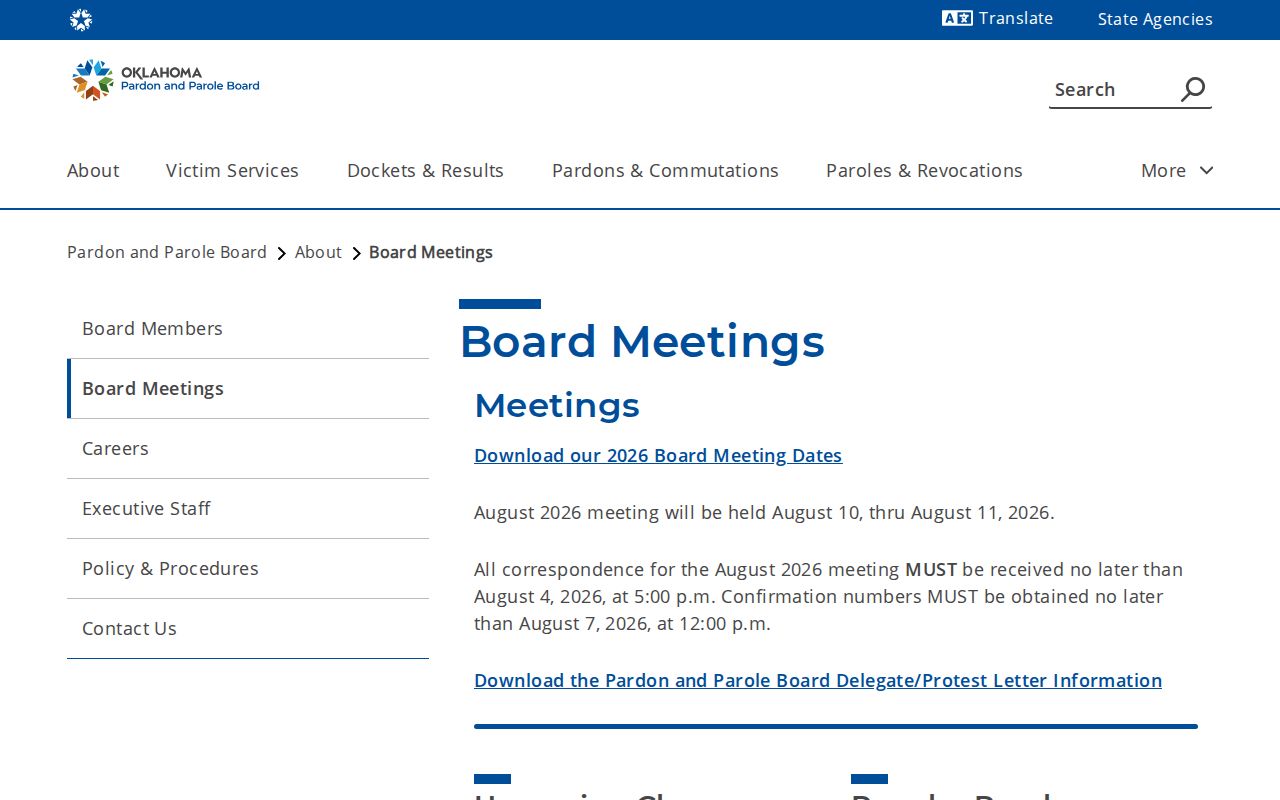
The calendar documents the hearing schedule, while the ODOC record remains the source for completed prison departure and later supervision status.
Eligibility depends on the offense, offense date, sentence, prior record, and statute. Oklahoma’s offense-specific 85-percent rule does not govern every sentence. Even when it applies, reaching the threshold means eligibility for consideration, not a right to parole. For timing details, use the Custer County release date lookup and keep Board action separate from ODOC’s calculation.
Custer County Absconder Status
ODOC maintains a separate public fugitive search. An absconder result usually means the person had been outside secure custody and is now wanted for an alleged supervision violation. It is not a discharge record. It also does not show that a member of the public should locate, confront, or attempt to detain the person.
Compare the same identifiers used in the main offender lookup. If a credible match appears, the ODOC Fugitive Warrants Division publishes 405-425-2570, 405-425-2571, toll-free 866-363-1119, and warrants@doc.ok.gov. Urgent danger belongs with emergency services. Questions about a normal reporting schedule or condition should go to the supervising office, not the warrant channel.
Open the official ODOC fugitive search to see the separate statewide path.
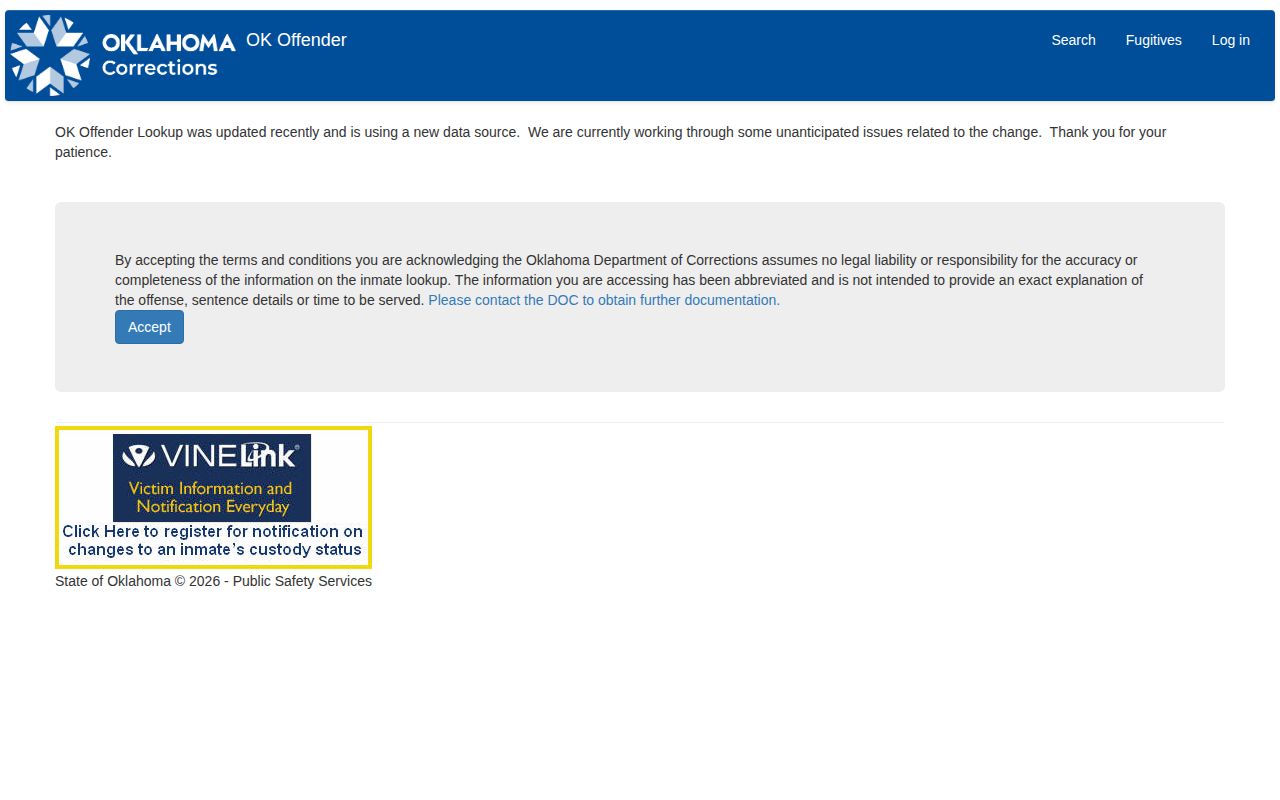
The image shows why an absconder check should not be confused with an ordinary ODOC status search or a proof of discharge.
Alleged violations can lead to a warrant, arrest, revocation proceeding, or return to custody. Revocation means a court or supervising authority acts on an alleged breach and may change the community status. The Custer County docket can supply legal context, while ODOC owns its supervision and warrant records.
Custer County Supervision Conditions
Conditions are the rules attached to parole or probation. They vary by judgment, parole documentation, and individual plan, so no single public list proves what applies to one person. Common records may address reporting, approved residence, travel, treatment, financial duties, or contact limits, but only the controlling documents and assigned officer establish the actual terms.
A public registry is not a general supervision list. Oklahoma’s sex-offender and violent-offender registries cover only people with a statutory registration duty. A registry match may continue after release and may show identity, photo, offense, and jurisdiction information. No match does not establish discharge, current confinement, or freedom from supervision. Likewise, Oklahoma VINE is a custody-notification service, not a probation reporting record.
When records conflict, preserve the conflict. Note which system was searched, the search date, and the identifiers used. A recent ODOC entry may lag a court filing, or a public docket may omit a sealed event. The official record custodian should confirm the exact fact that office owns.
Custer County Supervision Discharge
Discharge is the formal completion or end of the relevant corrections or supervision term. It is stronger than release from secure custody. A person on parole has left prison but remains under the sentence; a person shown discharged has reached a different legal and administrative milestone. Separate active cases, registry duties, or another jurisdiction’s order may still exist, so the whole record should be read.
For a public state record, use ODOC Legal Services or the agency’s discharge channel. A focused request should include the full name, aliases, date of birth, ODOC number, and Custer County case number. Ask for the completed release or discharge date and category, public custody status, and public supervision status. ODOC publishes osordischarges@doc.ok.gov for discharge questions, Legal Services at 405-425-2515, and Closed Records at 405-425-2691.
Court satisfaction or dismissal entries may add context but do not replace the ODOC record. A deferred-sentence update under Section 991(c) also differs from a full expungement under Sections 18 and 19. If a public result is missing, report only that it was not found in the named system and seek the official record rather than assuming supervision never existed.
Note: Confirm discharge through the agency that administered the term, because leaving prison and completing all supervision are separate events.