
Custer County Jail Release Paths
Custer County Sheriff’s Office custody can end in several ways. Bond, recognizance, dismissal, a court order, time served, or completion of a county sentence may result in a return to the community. A felony commitment may instead move the person to the Oklahoma Department of Corrections. An open warrant can lead to another county, a federal matter to the U.S. Marshals Service, and an immigration detainer to ICE. Medical or treatment placement is another possible destination. Each event ends the Custer County Jail segment, but only some are community releases.
The sheriff’s release entry is the key record because it can establish the actual departure time, reason, and receiving agency when those fields are public. A court docket can show the order behind bond, dismissal, or commitment. Oklahoma VINE may report a custody change. Neither source should be forced to answer the question owned by the jail. If a name vanishes from the roster, state only that the current page did not confirm custody until another record supplies the destination.
A bonded-out case shows why the sources must remain separate. First use the current roster to identify the booking and charges. Next read the court docket for the bond instrument or order. Check VINE for a later event, then ask the sheriff for the actual release date, time, and disposition. Bond can be posted before identity checks, other holds, paperwork, or transport are complete. If the sheriff records bond as the reason but gives no destination, report release on that booking after bond without claiming the person went home.
Community path
Confirm the jail’s departure time and release disposition. A bond filing alone proves legal authority, not the moment processing ended.
Transfer path
Match the county departure to an ODOC, another-county, USMS, or ICE record before describing where the person went.
Confirm Custer County Jail Release
Begin with the official Custer County inmate search. It says the results are in-custody inmates and that the page updates hourly. Presence supports current county custody at the search time. Absence is not a released-person result because the page has no historical release view, release date, or archive. The sheriff’s own empty-result message directs users to VINE when someone may have been released or transferred.
- Match identity. Compare full name, aliases, birth date or age, booking number, photo, charges, and case number.
- Record the search time. The hourly cadence describes refresh timing, not a promise of removal within sixty minutes.
- Check the legal event. Use the Custer County court docket for bond, dismissal, sentence, commitment, or another order.
- Check the next system. Search VINE and, when facts point there, ODOC, another county, BOP, USMS records, or ICE.
- Request the release entry. Ask the sheriff for actual departure time, disposition, and destination.
The full county search and records sequence is also explained on the Custer County released inmates home page. Keep the systems in order. A court order may precede departure by hours, and an ODOC sentence can leave someone at the county jail while transport is pending.
Custer County Jail Release Record
A focused request should identify the person and a narrow booking or date range. Include the booking number if known. Ask for the booking date and time, actual release date and time, public release disposition or reason, authority or order, destination or receiving agency, related case and charges, public bond details, and booking photograph. The jail may use a code instead of plain words. If so, ask for the public meaning of that code.
| Requested field | What it helps establish |
|---|---|
| Booking number and date | Connects the request to the right custody episode. |
| Actual departure time | Shows when Custer County Jail custody ended. |
| Disposition or reason | Distinguishes bond, court order, sentence completion, transfer, or another event. |
| Destination | Separates community release from movement to another custodian. |
| Case and charge identifiers | Links the custody event to the right court file. |
The sheriff’s public roster endpoint includes booking and identity fields, charges, and a picture filename when an image exists. It does not expose a public release date, release reason, destination, or recent-release flag. That gap makes a direct request important. Juvenile, sealed, security, medical, victim, and active-investigation limits may restrict some material. Ask for the separable public parts rather than assuming an entire file must be produced.
Custer County Jail Records Contact
Send a narrow Oklahoma Open Records Act request to the Custer County Sheriff. Electronic copies may be requested, but delivery by email is not assured. No sheriff-specific online release form, photo fee, copying schedule, response time, or public retention period was found. Ask for a cost estimate, available format, and whether inspection or pickup will be required before making a trip.
Custer County Sheriff’s Office
Street: 300 N. 7th Ave., Arapaho, OK 73620
Mail: P.O. Box 40, Arapaho, OK 73620
Phone: 580-323-1616
Fax: 580-323-6262
Email: sheriff@custercountyso.com
Posted hours: County directory 8:00 a.m.–4:00 p.m.; sheriff administration Monday–Friday 8:30 a.m.–4:30 p.m.; dispatch 24/7.
The sheriff contact page body contains an apparent 580-232-1616 typo. The site header and county directory consistently publish 580-323-1616, so that number is used here. Confirm current office access before traveling.
Custer Jail Records May Require Pickup
Wagner v. Office of Sheriff of Custer County gives a county-specific lesson about access. The court held that Oklahoma law requires prompt and reasonable inspection and copying, but it does not compel the sheriff to deliver responsive records by email. In that case, reports were located and weekday pickup was required.
State a preference for electronic copies, then ask the records custodian to confirm the actual delivery method. Also ask for notice before costs are incurred. A valid fee schedule, if adopted, must be posted at the principal office and with the county clerk. This ruling does not prove that every new request requires pickup. It shows why format, cost, hours, and availability should be settled before travel.
Note: The official record controls even when a roster, court page, or notification supplies useful supporting context.
Six-Month Release Date Rule
The official Custer County Jail visitation policy uses a past release date in an unusual local restriction. A person who was incarcerated in the detention center may not visit another inmate for six months after that person’s release date. The rule makes the authoritative date relevant even after the public roster card has disappeared.
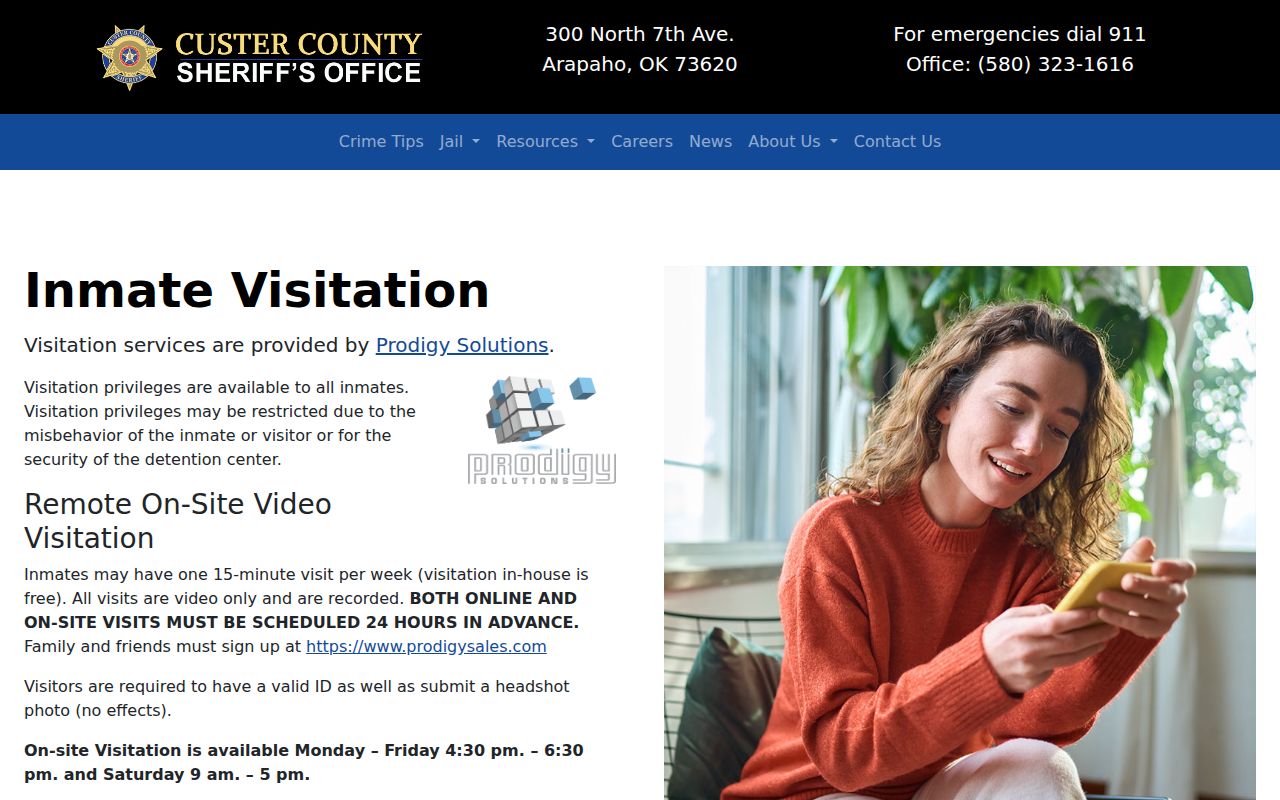
The policy screenshot shows why an approximate date or court filing may not be enough for visitation planning. Ask the jail which recorded release date applies and how it counts the six-month period. The rule is not a public release database and does not disclose another person’s history by itself.
Custer County Release Entry Points
The Oklahoma Office of Juvenile Affairs authorized-jails material identifies Custer County, Clinton, and Weatherford as three local custodial entry points. That matters because a city arrest can end with municipal release or a transfer into Custer County Jail. Identify the arresting, booking, and releasing agency before requesting a record. A city police log will not necessarily contain the later county departure.
The OJA document has a narrow evidentiary use. Its context concerns authorization for limited juvenile holding. It does not prove current adult capacity, ordinary release hours, or a published release schedule. Use it to map possible agencies, then use the actual custodian’s record to verify the individual event. When the city record says “transferred,” match it to a county booking rather than calling the city departure a return to the community.
Resolve Custer Jail Release Conflicts
Sources may show different times because they record different acts. A bond docket entry can show when authority was filed, while the jail log shows when processing ended. VINE can show when a custody event was transmitted. An ODOC entry can show later reception. Preserve each timestamp and its source instead of choosing the earliest one as the release time.
If two people share a name, compare booking and case numbers, date of birth or age, aliases, photo, charges, and relevant dates. A name and rough age are not enough when another identifier conflicts. If no destination is public, report only that Custer County custody ended. Do not claim the person went home. That precise wording keeps a county release, transfer, state reception, and later discharge from becoming one misleading event.
A time-served or sentence-completion case needs the same care. The docket may show the judgment and jail-credit award, but another case can keep the person confined. No official Custer County jail credit schedule or verified early weekend-release rule was found. Do not apply ODOC credit levels to a county sentence, and do not move a date to Friday because the expected end falls on a weekend. Request the recorded departure and authority. If the court date and jail date differ, preserve both while asking whether another hold, credit, or processing explains the gap.